
Note: I wrote the original version of this essay in 2020 for the undergraduate course English 352: Short Story with Dr. Steve Farmer at ASU.
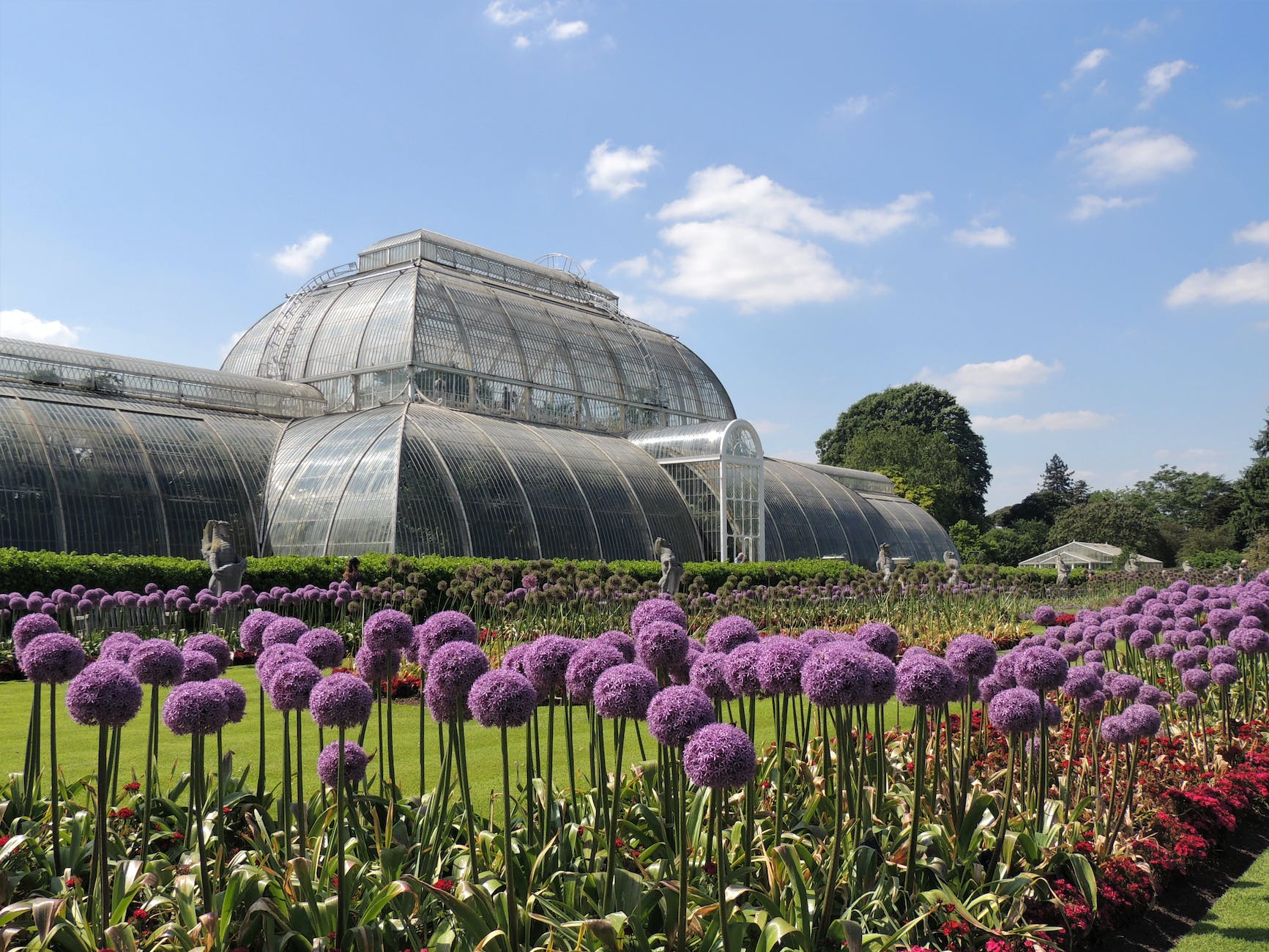
If Virginia Woolf’s work is to be judged by any of her critical words, then let them be that “any method is right, every method is right, that expresses what we wish to express,” and that “there is no limit to the horizon” (“Modern Fiction” 8, 9). Through the tempting relativism of her words lies the promise of direction and follow-through. If the shapelessness that she professes is as pioneering as she claims, then let her show us the salvation of the modern, let her show us how to capture the life that “escapes” so often in misguided moralizing attempts at literary indelibility (“Modern Fiction” 7). Like the “spiritual…flickerings of that innermost flame which flashes its messages through the brain,” Woolf, as a literary ecclesiastic guiding us through a dappled sanctuary of light and color, does indeed reveal the “other aspects of life” in her short story “Kew Gardens” (“Modern Fiction” 8). She transforms the garden into a modernist church where the mutability of words is sacrosanct, beginning with a bursting cacophony of color and confusion, as “perhaps a hundred stalks” come alive with “heart-shaped or tongue-shaped leaves,” and a “red, blue, or yellow gloom of the throat,” from which emerges “a straight bar, rough with the gold dust and slightly clubbed at the end” (“Kew” 1689). As if to prove her experimentalism, she dashes the Romantic notions of incorruptible nature by placing in our minds a creature with the grotesque incoherence of tentacles rising up from the ground until ah!—they are but flowers “stirred by the summer breeze” (“Kew” 1689).
The strength of Woolf’s writing within “Kew Gardens” is that she examines the parts of life that are often missed by traditional literature. That is to say, she explores the nexus of imagination and perception, the magic of life that we so often perceive faint feelings of, like the softest feather tickling the depths of our mind, but that we rarely are able to express on grand scales that make sense to us intellectually rather than viscerally. These are the “atoms [that] fall upon the mind,” the stained glass of the “red, blue, and yellow lights” of flowers “staining an inch of the brown earth beneath with a spot of the most intricate colour” (“Modern Fiction” 8, “Kew” 1689). Woolf takes thoughts without words—those pre-literate neuronal firings that reside deep within our psyche—and coaxes them out into the literary light. To see the world clearly and fancifully is a gift; to articulate how “instead of rambling vaguely the white butterflies dance one above another, making with their white shifting flakes the outline of a shattered, marble column above the tallest flowers” is divine (“Kew” 1693). Woolf enlarges the minute amongst the garish gigantism of the things we deem important in quotidian life—is it not these fleeting moments that bring so much holiness to the transiency of our experiences? These are the “myriad impressions” of the mind, the “incessant shower of innumerable atoms” that “shape themselves into the life of Monday or Tuesday” (“Modern Fiction” 7). Like “Mr. Joyce” and the Russian writers she mentions with envy, Woolf creates within her microcosmic world of “Kew Gardens” an impressionistic painting of perception in its rawest form.
Woolf does not, however, wallow in her pools of light and color, risking pure sentiment, but rather reminds us too of the clashing world that makes such moments so remarkable. Men and women weave in and out of the story “with a curiously irregular movement” that is like that of “the white and blue butterflies” (“Kew” 1690). “The man”: he enters our vision with demanded familiarity, and suddenly the general is startled into the specific, our eyes forcefully jerked to focus upon a man and woman (“Kew” 1690). They are the man and woman, creatures whose speech is so reminiscent of quietly private thoughts that it seems a vulgarity that they interrupt the garden church with such tastelessness (“Kew” 1690). We sigh with relief as they walk away, “diminish[ing] in size among the trees” and looking “half transparent as the sunlight and shade swam over their backs in large trembling irregular patches,” thanking or cursing them for diverting our gaze (“Kew” 1690). The spirit of nature comes alive again, then, with the return of the flower bed and the focus drawn upon a “snail, whose shell had been stained red, blue, and yellow for the space of two minutes or so” (“Kew” 1691). Oh, but for those two minutes how we were diverted, how much we can miss when our gaze goes astray! And how quickly our gaze is diverted once again from the snail’s struggle of whether to “circumvent the arched tent of a dead leaf or to breast it” when the irreverent coarseness of human beings shocks us from our molluscan meditation (“Kew” 1691).
Woolf’s focus upon the world of the snail amongst the giant, interrupting humans is a perspective choice that marks her work as modern. In “Kew Gardens,” the snail is “the emphasis…upon something hitherto ignored” (“Modern Fiction” 8). In a postmodern—or post-postmodern—world, such specificities in literature seem given, perhaps even trite, but it is writers like Woolf who gave such formlessness form and meaning. Woolf deliberately “break[s] and bull[ies]” the personified “art of fiction,” pushing the boundaries of literary possibility and permissibility (“Modern Fiction” 9). Her story is without definite structure, as fuzzy as the flowers shedding colored light upon the ground. She turns this garden scene into a sacred place, a cathedral of light, color, and meaning down to the quantum level where time and literary conventions dissolve. More people come and go, the snail returns, and his struggle is delayed again. We observe these peoples’ words and comparatively inelegant actions, and then, as if we have caught enough of an anthropological glimpse to plumb the depths of such a strange, interruptive species, the couples blur together “with much the same irregular and aimless movement” (“Kew” 1693). The church of nature arises again in all its detailed glory, as the people with their “gross and heavy bodies…dissolve…like drops of water in the yellow and green atmosphere” (“Kew” 1693). But then suddenly their “wordless voices” return to gather into this cathedral’s chorus, as it rises through the sultry air and the…not silence. Not silence at all, “there was no silence” (“Kew” 1693). The sounds of the city march on in the distance, and the moment of stillness is broken as the world floods back with roaring intensity, and the temporary illusion of sublimity collapses into chaos and crowds.
The weight and wideness of this new world is confusing and speaks to the “vague and inconclusive” short stories that Woolf dares to allow (“Modern Fiction” 9). As she writes about the “inconclusiveness of the Russian mind”:
“[It] has the sense that there is no answer, that if honestly examined life presents question after question which must be left to sound on and on after the story is over in hopeless interrogation that fills us with a deep, and finally it may be with a resentful, despair.”
Virginia Woolf, “Modern Fiction,” p. 9
Woolf, however, speaks of Russian writers with admiration and the fear that “one runs the risk of feeling that to write any fiction save theirs is a waste of time” (“Modern Fiction” 9). But Woolf’s fears are misplaced, as she indeed reaches this trembling poignancy in the fact that, unlike in much traditional literature, we do not know the characters’ fates. We all wish to be gods with a voyeuristic omniscience that fulfills our base desires to know and judge, but Woolf reins us in and lets us sit with our greedy eyes in the confounding tristesse that we will never know more than the little she gives us. Woolf prevents us from venturing too far into the sharp world of judgment; we don’t know enough of these passing characters to feel confident in our prophecies. But, though disconcerting, isn’t this choice an act of poignant sympathy, in line with the Russian writers she reveres? Somehow it is just enough to know that these people exist, and that Woolf immortalizes the quickness of life, leaving us with a residue of memory and perception and the realization that yes, profundity can indeed be found in boundless experimentation.
Works Cited
Woolf, Virginia. “Kew Gardens.” The Norton Anthology of Short Fiction, 8th edition, edited by Richard Bausch and R.V. Cassill. W.W. Norton & Company, 2015, pp. 1689-1694.
—. “Modern Fiction.” 1921.
 Kathleen Swain