
Source: www.tclf.org/landscapes/gas-works-park
Note: I wrote the original version of this essay in January of this year for the graduate course English 504: Posthumanism with Dr. Jason Bryant at ASU on the topic of Anna Lowenhaupt Tsing’s book The Mushroom at the End of the World: On the Possibility of Life in Capitalist Ruins.
In The Mushroom at the End of the World, Anna Lowenhaupt Tsing asserts the telling of stories as a “method,” even “a science” with “[i]ts research object…contaminated diversity; its unit of analysis…the indeterminate encounter” (37). In similar fashion, I now turn briefly to Gas Works Park in Seattle, Washington.
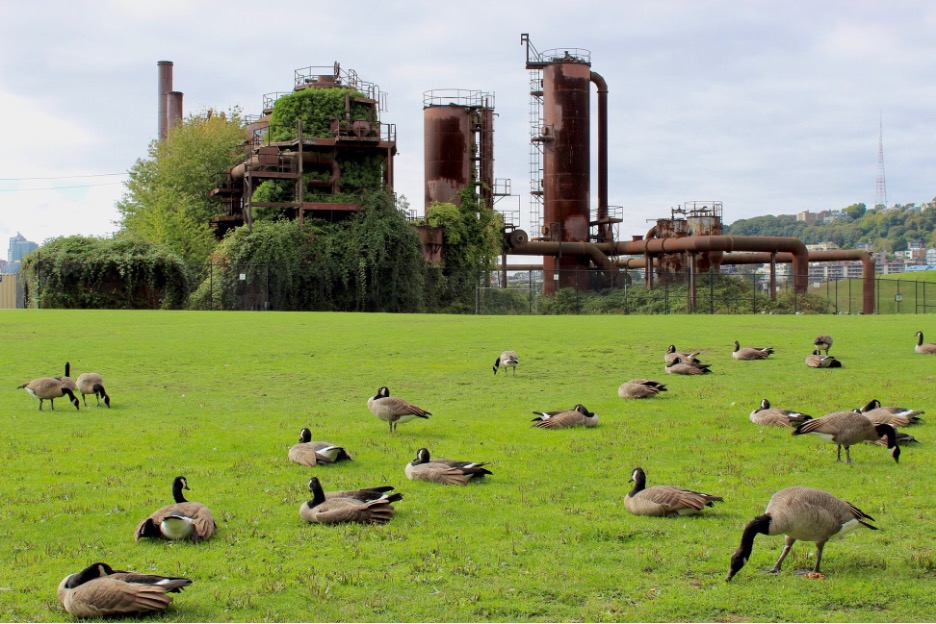
Like the “satoyama” forests of Japan and the remains of the logging industry in “Oregon’s eastern Cascades,” Gas Works Park stands as “a legacy of progress” (Tsing 151, 193; Mackay 12). Built on the site of an early 20th-century “coal gasification plant,” Gas Works Park provides a way to think on Tsing’s concepts of capitalism, history, contamination, patches, multispecies assemblages, and latent commons (“Gas Works Park”). Left to decay, the city of Seattle bought the old gas plant and in 1976 “opened [it] to the public” as a park (Mackay 40). Instead of covering up the land’s past use, however, landscape architect Richard Haag incorporated many of the plant’s buildings into the park design (“Gas Works Park”). Rusted red-brown metal tanks, stairs, and pipes stand on lush green lawns, a dissonance that many of us are not used to. But why are we not used to such sites? As Hailey Mackay writes in her master’s thesis Enhancing Legacy / Engaging Process: Phytoremediation at Gas Works Park, “[a]s early-industrialized nations continue to export manufacturing industries, post-industrial landscapes are increasingly common,” however “[d]eep levels of contamination” from industrial processes make such landscapes difficult and costly to remediate (1). Because of this, Gas Works Park remains an exception, with most other post-industrial sites set aside to make room for “progress.” But such sites are themselves reminders of the hegemony of capitalist progress. Gas Works Park then reveals something strange about capitalism: it doesn’t like to look back on its own history. Tsing writes of “industrial tree plantation[s]” as examples of capitalism’s desire to erase history through uniformity and productivity, calling attention to “alienation” (167-176, 123). But Gas Works Park shows that capitalism also alienates itself from the history of progress. Landscapes are used and then left for the next site. Capitalist logics cannot accommodate remediation into its system of forward motion. Remediating land takes time, multispecies relationships, and money.
Gas Works Park seems to stand in the face of this logic. In the process of making the gas works site into a park, “Haag used a variety of organic matter and bacterial microbes to begin remediating [polluted] soils” (Mackay 12). Mackay’s own thesis explores the use of “phytoremediation,” or “the use of specialized plants to absorb or otherwise mitigate pollutants,” as way to clean up soil in Gas Works Park (1). With such remediation comes multispecies “assemblages,” where bacteria, plants, fungi, and urban animals exist within one space (Tsing 22-23). This recalls Tsing’s “patchiness,” and is one example of “disturbance-based ecologies in which many species sometimes live together without either harmony or conquest” (4-5; italics removed). Looking at the old industrial metal among the “nature” of the park is uncanny, as it flies in the face of what we’ve come to expect from capitalistic progress. Haag’s design shows how we may live with our past and with other beings, defying capitalism’s urge to look away and look forward.
Even more, contamination still remains, a state that echoes Tsing’s assertion that “[e]veryone carries a history of contamination; purity is not an option” (27). Gas Works Park takes this premise literally, as “contamination created by the now statuesque towers still lies buried beneath [visitors’] feet” (Mackay 2). Phytoremediation keeps “leaching” at bay, with “plant roots” locking toxins below the surface (Mackay 1). But, as the metal towers remind us, history remains. That history includes a “traditional fishing area used by Native Americans,” its traces left in a salmon migration route that runs past the edge of the park in Lake Union (Mackay 35, 39). Gas Works Park invites reflection on human-nonhuman relationships, contamination, capitalism, and history. We find beauty in this ruin, a ruin that stimulates a posthuman sense of unease: time moves laterally between past and present, and space moves vertically up to the towers and down to the contaminated soils below. While the park itself also came about because of capitalism, following outsourcing and the desire of people in cities to encounter “nature” among new tech industry—Mackay also emphasizes the biophilic “value” of the park—I’d rather move such cynicism aside to appreciate what thought processes the strangeness of the park may create (1). Hopefully it reminds us of precarity and the heterogeneity of being.
Source: twitter.com/stormyjd/status/1050184091528617984/photo/4
I’ll end this brief story of Gas Works Park with an assessment of the site as a “latent commons,” based on Tsing’s criteria on page 255 of her book:
- “Latent commons are not exclusive human enclaves.” Gas Works Park has multispecies assemblages built into its design. Humans and plants play on the surface. Bacteria and fungi play beneath, digesting contaminants and fixing nitrogen for plants in an array of mutualisms. Humans may have led the site to this configuration, but humans alone did not make the park exist.
- “Latent commons are not good for everyone.” Who benefits from this park? Who lives close enough to enjoy the park in an affluent city like Seattle? What forests and shores were lost in the process of getting to this present?
- “Latent comments [sic] don’t institutionalize well.” Gas Works Park is a successful public project, but it won’t work anywhere. Capitalist logic precludes remediation of most post-industrialist spaces, as noted above.
- “Latent commons cannot redeem us.” Gas Works Park cannot make up for the damage that capitalism still creates. While one affluent city in an affluent country can make beauty from ruins, other parts of the world must still suffer in ruins. We must live “amidst the trouble” (Tsing 255).
This trouble surrounds us now, as we all know acutely. Working with the trouble and understanding precarity as a process of creation and reorientation gives us somewhere to go, even if we don’t know where that is.
Works Cited
“Gas Works Park.” The Cultural Landscape Foundation, 2020, www.tclf.org/landscapes/gas-works-park Links to an external site.. Accessed 26 Jan. 2022.
Mackay, Hailey. Enhancing Legacy / Engaging Process: Phytoremediation at Gas Works Park. 2016. University of Washington, master’s thesis.
Tsing, Anna. The Mushroom at the End of the World, Princeton UP, 2015.
 Kathleen Swain